
Business English for real workplace conversations
You already know English.
Now learn how professionals
actually speak at work.
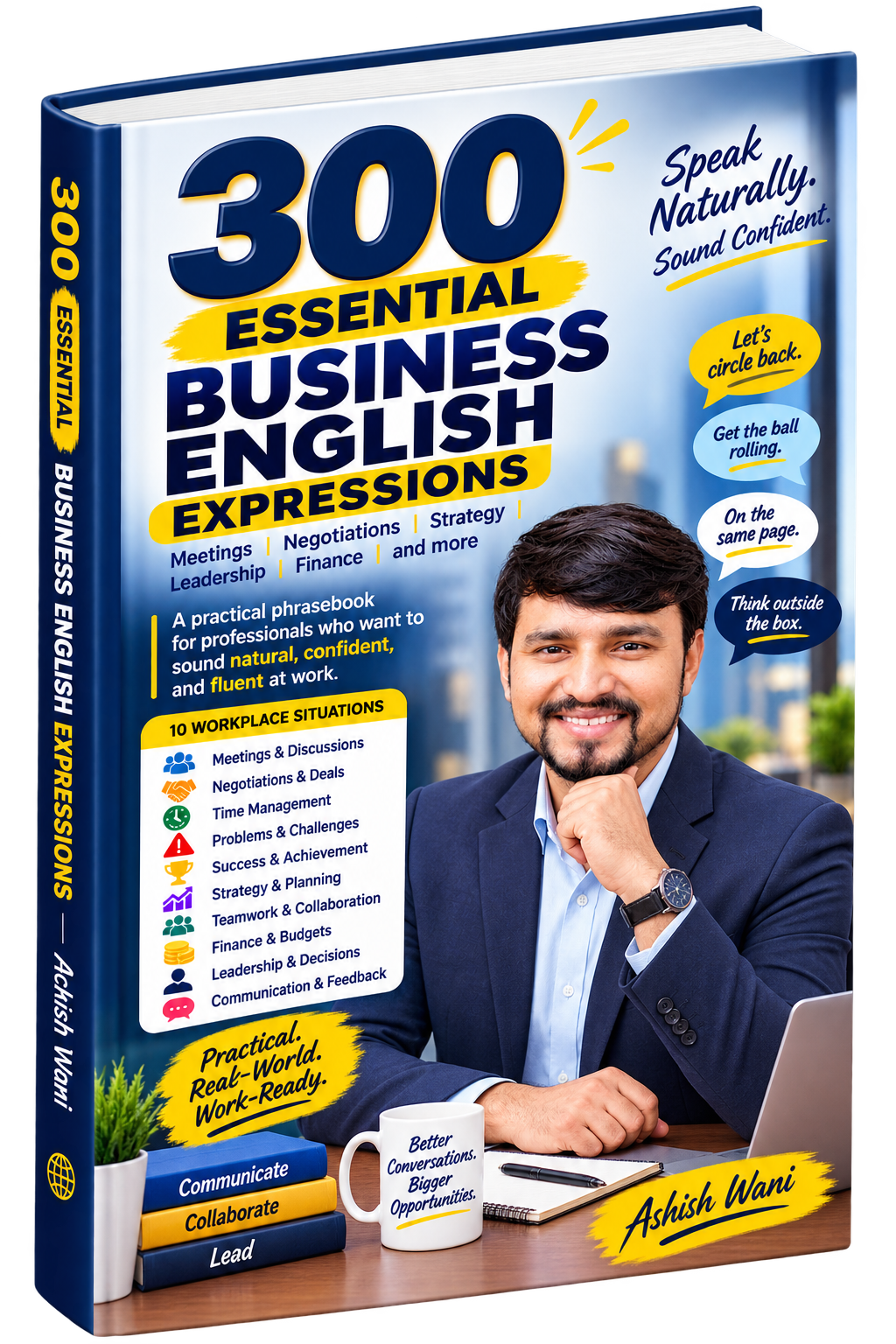
300 real business expressions used in meetings, negotiations, deadlines, strategy, finance, leadership and feedback — each one with a plain-English meaning, a realistic workplace example, its level of formality, and an alternative phrase.
Stop translating your thoughts sentence by sentence. Start recognising — and using — the phrases your colleagues and clients already use.
- ✓ 300 expressions
- ✓ 10 workplace categories
- ✓ 85-page PDF
The real problem
Does this sound familiar?
You freeze mid-sentence
You know exactly what you want to say — but not the phrase professionals would use to say it.
You reuse the same few phrases
"I will do it", "I will inform you", "please find attached" — safe, correct, and a little flat.
Colleagues use expressions you were never taught
"Put a pin in it", "run the numbers", "loop me in" — no grammar book covered these.
You translate in your head first
By the time the sentence is ready, the conversation has already moved on.
Your emails don't land the way you intended
Sometimes too formal, sometimes too blunt — hard to judge the right tone.
You stay quiet in meetings you could lead
Not for lack of ideas — for lack of the wording to put them across quickly.
For many professionals, the gap isn't grammar. It's exposure — you simply haven't met enough of the language people actually use at work.
Why it happens
Business English is more than grammar
Workplace conversation runs on a repeating set of expressions. They aren't difficult words — they're familiar words arranged in ways you have to have met before to use comfortably.
Knowing an expression academically is not the same as recognising it instantly in a call and reaching for it without thinking. That comes from seeing it in context, with the meaning, the tone and a real example beside it.
"Let's circle back."
"Can you run that by me?"
"What's the bottom line?"
"Let's put a pin in it."
"We need everyone on board."
The format
Every expression gives you more than a definition
This is what one of the 300 entries looks like inside the book.
You learn the expression
Grouped with the situation it belongs to, so it's easy to find again.
You understand what it means
Plain English — no dictionary definitions to decode.
You see how professionals use it
A realistic sentence from an actual workplace situation.
You know the tone
Formal, neutral or informal — so you can judge when to use it.
You get an alternative phrase
A second option for when the first doesn't fit the room.
What's inside
Ten chapters, thirty expressions each
Organised by the situations you actually walk into — so you can open the chapter that matches your week.
01
Meetings & Discussions
30 expressions
02
Negotiations & Deals
30 expressions
03
Deadlines & Time Management
30 expressions
04
Problems & Challenges
30 expressions
05
Success & Achievement
30 expressions
06
Strategy & Planning
30 expressions
07
Teamwork & Collaboration
30 expressions
08
Finance & Budgets
30 expressions
09
Leadership & Decision-Making
30 expressions
10
Communication & Feedback
30 expressions
Sample expressions
Expressions you'll start recognising everywhere
Get the ball rolling
To start something, such as a project or a discussion.
NEUTRALTouch base
To make brief contact with someone to check on progress.
NEUTRALCut to the chase
To get to the main point without wasting time.
INFORMALLoop someone in
To include someone in a conversation or email so they stay informed.
INFORMALDrill down
To examine something in much greater detail.
NEUTRALBreak even
To reach a point where costs equal revenue — no profit, no loss.
NEUTRALBang for your buck
Good value in return for the money spent.
INFORMALTake ownership
To accept full responsibility for a task or outcome.
FORMALTake the reins
To take control or leadership of a situation.
FORMALSet the tone
To establish the general mood or approach for a situation.
NEUTRALRead between the lines
To understand a hidden or implied meaning.
NEUTRALStep up to the plate
To take responsibility and act, especially when needed most.
INFORMALAnd these are only a few of the 300 expressions inside.
Benefits
What this book can help you do
Speak more naturally
Build familiarity with expressions commonly heard in professional conversations.
Follow meetings more easily
Recognise the phrases colleagues and managers use during discussions.
Widen your professional vocabulary
Move beyond repeating the same handful of basic words and sentences.
Write better workplace messages
Develop familiarity with wording that works in emails and business writing.
Contribute more confidently
Have a larger library of expressions ready when you want to speak up.
Judge tone before you speak
Every entry tells you whether it reads formal, neutral or informal.
Work more comfortably across borders
Get used to the English-language conventions of international teams.
Prepare for interviews
Use professional language more confidently when it counts most.
This eBook is for you if…
- ✓ You work with international clients or teams
- ✓ You attend meetings and calls in English
- ✓ You work in IT, engineering or technology
- ✓ You're a manager, team lead or project manager
- ✓ You're a consultant, freelancer or entrepreneur
- ✓ You're preparing for interviews in English
- ✓ You're a student stepping into corporate life
- ✓ You understand English but want to sound more natural
- ✓ You want practical English, not another grammar textbook
This may not be for you if…
- — You're looking mainly for a beginner grammar textbook
- — You expect fluency without practising
- — You want academic linguistics or exam theory
- — You're already at ease with a wide range of modern workplace expressions
We'd rather you skip it than buy the wrong book.
How to use it
Don't memorise 300 expressions at once
The book is written as a reference you return to — not a course you finish. Here's the approach it recommends.
STEP 1
Pick the chapter closest to your actual work this month.
STEP 2
Take 5–10 expressions — no more than that in a week.
STEP 3
Read each workplace example out loud so the rhythm sticks.
STEP 4
Start noticing them in meetings, emails, calls and videos.
STEP 5
Use one or two where they genuinely fit — then repeat.
Same meaning, different feel
Correct English — and the version that sounds like the room
Nothing on the left is wrong. The alternatives on the right simply tend to sound more natural in everyday workplace conversation.
Inside your copy
Exactly what you receive
About the author
{{ authorName }}
{{ authorBio }}
Upgrade the English you already know
Build a practical library of expressions you can recognise and use across meetings, negotiations, emails, leadership conversations and everyday professional situations.
FAQ
Questions before you buy
Is this a physical book?+
No. It's a digital eBook delivered as a PDF — nothing is shipped.
How will I receive it?+
After successful payment, the payment gateway redirects you to a download page where you can save the PDF.
Is it suitable for beginners?+
It's most useful if you already read and understand everyday English. The book assumes that base and focuses on workplace expressions, their meanings and how they're used — it isn't a first English course.
Is this only for managers?+
No. The chapters cover meetings, deadlines, teamwork, problems, finance and feedback — situations that come up for engineers, analysts, consultants, freelancers, job seekers and students as much as for managers.
Does it teach grammar?+
Not as its focus. Each entry gives you the expression, its meaning, an example, its register and an alternative phrase. It's a phrasebook for work, not a grammar course.
Can I read it on my phone?+
Yes — it's a standard PDF, so it opens on any phone, tablet, laptop or e-reader with a PDF viewer.
Do I get instant access?+
After successful payment, you'll be redirected to the download page and can download the PDF straight away.
Can I share the eBook?+
It's licensed for the original purchaser's personal use and shouldn't be redistributed or resold.
Still have a question?+
Write to {{ contactEmail }} and you'll get a reply before you buy.
Get the eBook
{{ currency }}{{ salePrice }} · Digital PDF